
Agenda-setting intelligence, analysis and advice for the global fashion community.
Agenda-setting intelligence, analysis and advice for the global fashion community.

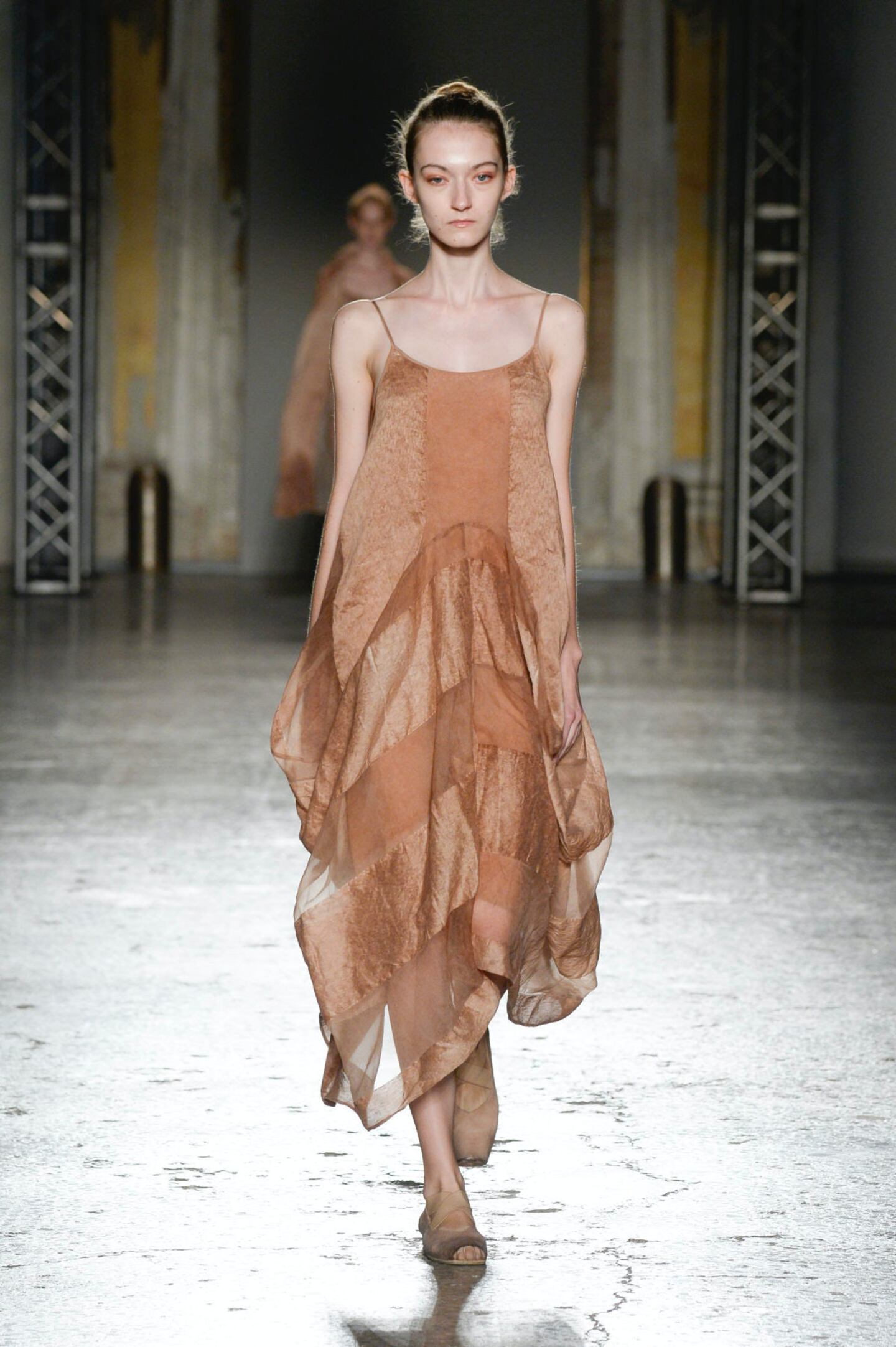
MILAN, Italy — When Erik Satie's Gymnopédie No 1 played in the background and a corps of very young ballet girls did pliés and petit sauts, there could be no doubt about the source of the inspiration for Uma Wang's Spring collection. What followed was a subtle and thoughtful exploration of how to make the body seem present, without putting it on display. In this way, Wang's clothes could be loosely categorised under the umbrella of 'poetic' fashion — a space more or less invented by Yohji Yamamoto in the 1980s — and the collection's earthy tones and crinkly fabrics almost made the clothes look found and salvaged. hems were often left unfinished, and prints and embroideries had a faded quality, as if they had been exposed to the elements.
One long dress, which was all black from the front, turned out to be a completely different outfit when viewed from the back, revealing part of the model's back and a pleated cream white skirt. At other times, the fabric was fastened to create new, asymmetrical shapes. In many ways, this kind of poetry has been lost in the current, Instagram-driven fashion climate — watching the collection you felt the urgent need to rediscover this sensibility. Unlike a statement outfit, these clothes invited you to let your gaze linger.
Speaking backstage of some of the more sand-coloured clothes, Wang explained how she wanted to merge or connect the clothes to the body, trying to achieve a nude look — even if the model was still very much covered. She achieved this almost perfectly in a long billowing, semi-transparent empire dress with a monochrome floral print. Catwalk images don’t do it justice. In reality, the model floated inside the dress, like a ghost, barely there, but still very much present.
There are obvious parallels between ballet and fashion. And this is not the first time, nor will it be the last, that ballet provides inspiration for a designer. For Wang, it was the tension between the fleeting beauty of a ballet performance and the long and arduous preparation that precedes it that provided the guiding light for the show. Speaking backstage, she seemed to realise, only then, that the same could be said about fashion: months of practice, followed by a few minutes of beauty.
Haider at Tom Ford, Pieter at Alaïa, comings and goings in fashion, and Nico at Courrèges coming up fast, all of it leading to a day of dynamic fashion in Paris, writes Tim Blanks.
One of the busiest days of Paris fashion week featured a hello at Balmain, a goodbye at Alaïa and variations on signature visions at Courrèges, The Row, Dries Van Noten and Tom Ford.
Controlled eroticism and an ’80s-inflected view on mid-century glamour were in focus at Tron’s debut show for the Mayhoola-backed Parisian brand.
After accusing the publication of ‘copying’ his remote viewing events, the creator hosted a live runway show in a 2,000-seat Paris theater.
The underwear company is anticipating net sales of at least $6.85 billion in the current fiscal year, exceeding analyst estimates and marking the highest revenue since its split from L Brands Inc in 2021.
The Japanese brand is accelerating its expansion in India to capture a greater share of the rapidly growing apparel market and affluent consumer base.
Strong growth at Miu Miu helped lift results, but the Italian luxury group said that integrating Versace will weigh on margins in the near term as it begins the turnaround of the struggling brand
Activist fund Oasis Management Co. is calling on the Japanese personal care company to convene an extraordinary general meeting, seeking a probe into its supply-chain risk management and internal control.


