
Agenda-setting intelligence, analysis and advice for the global fashion community.
Agenda-setting intelligence, analysis and advice for the global fashion community.

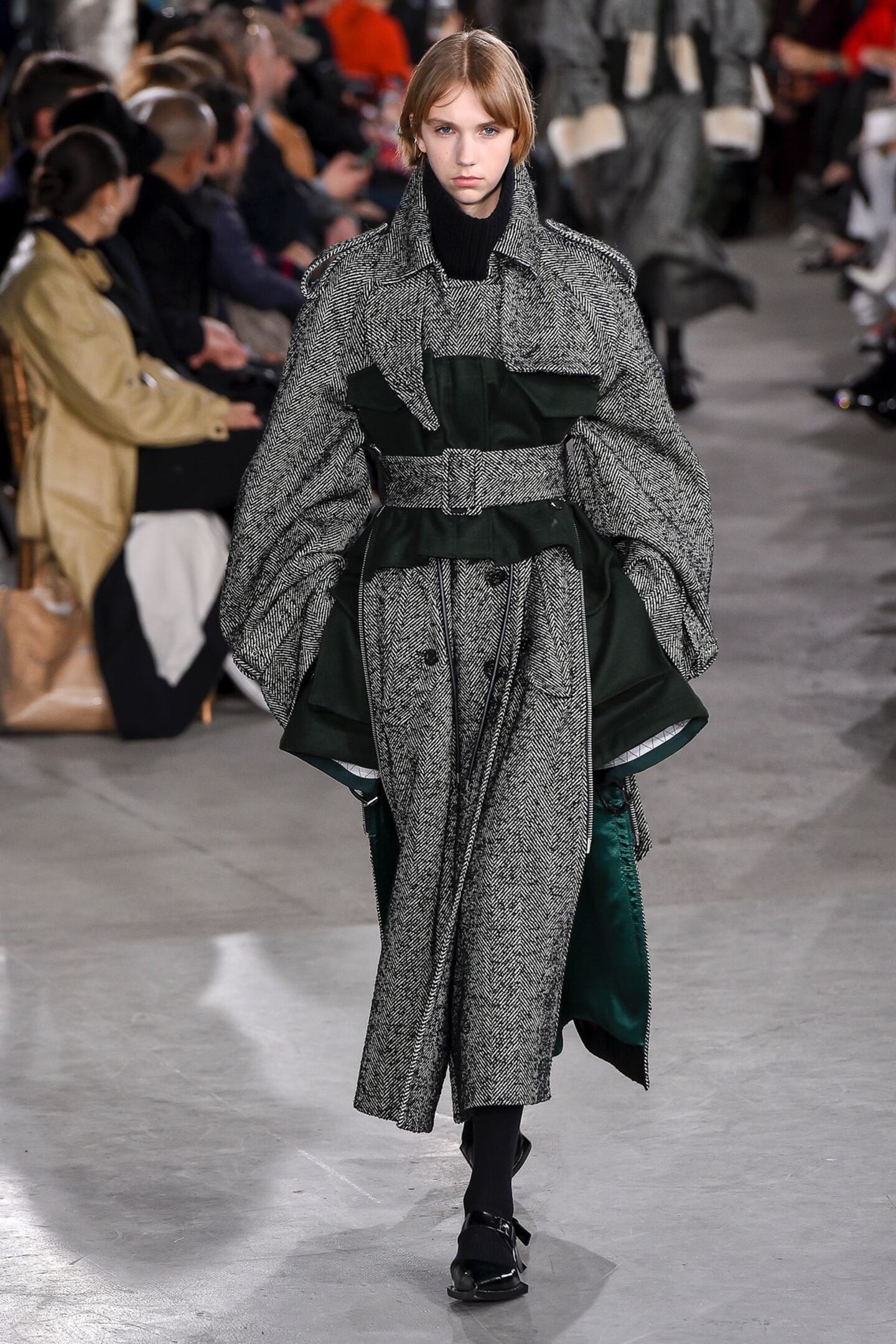
PARIS, France — If you consider that Chitose Abe grew up in Tokyo, her label Sacai's umbilical connection to New York street culture of the 1980s might strike you as a thing of wonder. Loose Joints' "Is It All Over My Face" bounced in and out of the soundtrack for her show on Monday. But to wonder at such a thing would be to forget how tireless Japan's fashion community has been in its fetishistic absorption of the warp and woof of Western pop culture.
In Abe's case, that has taken the form of a faith in the hybrid as a unifying principle, bringing together times, places, cultures in an idiosyncratic stew. It's not a notion that is endlessly renewing. There have been times when a Sacai collection felt a little too much like more of the same. But not on Monday. The mood was darker, stronger, more aggressive…and more readable. When Abe collages her hybrids, they sometimes lose focus. Here, they were layered in strong new silhouettes, like the flare of a peplum matching the flare of an accompanying skirt. Or they were ingeniously embedded, the way a little puffa bolero disciplined a billowing trench, or an elasticated waistband was set into the back of a coat. Smaller pieces on top of bigger pieces – that was the guiding principle. Abe said it tracked back to the way she used to layer her own clothes. Hence a cabled sweater stretched over a parka. Layering inverted. It reads as an arbitrary fashion indulgence, but it didn't look that way.
That’s always been the peculiar magic of Sacai, though it’s not a spell with infinite sustain. So it was heartening in a kind of bleak way to see the label going deeper, monochrome, militant. Abe acknowledged that Sacai is a somewhat abstract concept. That’s why the print of the season was a Jackson Pollock-like paint spew. Not an actual piece by Pollock, but the mess he left on the floor of his studio. Abstraction made concrete. Abe's analogy was obvious. What is left when the art is finished? In her case, it was the most direct, convincing collection she has shown in a while.
Haider at Tom Ford, Pieter at Alaïa, comings and goings in fashion, and Nico at Courrèges coming up fast, all of it leading to a day of dynamic fashion in Paris, writes Tim Blanks.
One of the busiest days of Paris fashion week featured a hello at Balmain, a goodbye at Alaïa and variations on signature visions at Courrèges, The Row, Dries Van Noten and Tom Ford.
Controlled eroticism and an ’80s-inflected view on mid-century glamour were in focus at Tron’s debut show for the Mayhoola-backed Parisian brand.
After accusing the publication of ‘copying’ his remote viewing events, the creator hosted a live runway show in a 2,000-seat Paris theater.
Christine Hunsicker admitted she falsified financial statements to promote CaaStle Inc. as a valuable, growing business when in reality it was struggling.
The American cosmetic giant’s buyout of Ayurvedic beauty line Forest Essentials came as a surprise. By picking an under-the-radar brand it knows well, the company can show that it’s still in the M&A game without needing to outbid rivals.
The underwear company is anticipating net sales of at least $6.85 billion in the current fiscal year, exceeding analyst estimates and marking the highest revenue since its split from L Brands Inc in 2021.
The Japanese brand is accelerating its expansion in India to capture a greater share of the rapidly growing apparel market and affluent consumer base.


