
Agenda-setting intelligence, analysis and advice for the global fashion community.
Agenda-setting intelligence, analysis and advice for the global fashion community.

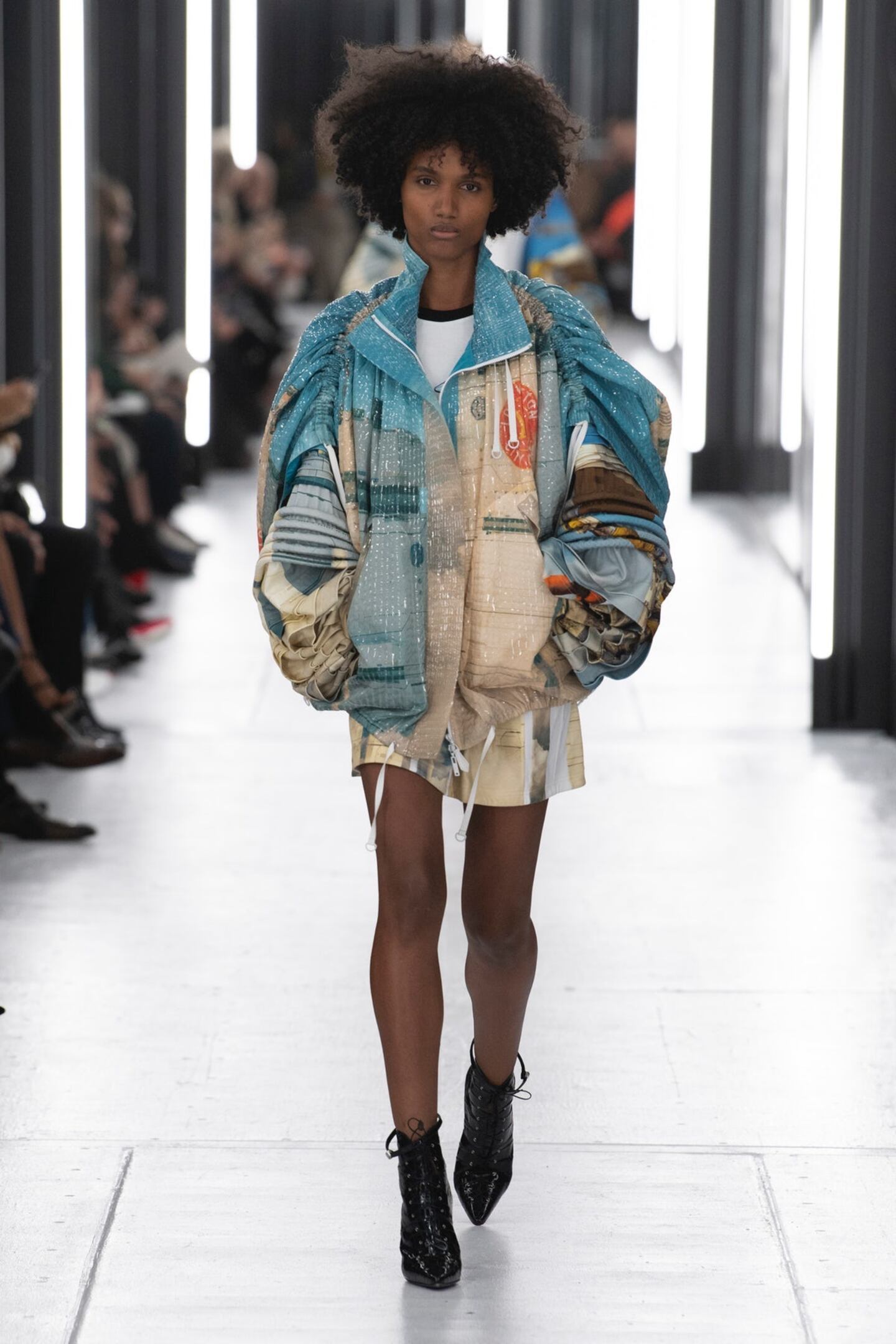
PARIS, France — The first thing you noticed as light and sound chased the models through the long tunnel that snaked its way round the Cour Carrée in the Louvre was the sleeves. Full pleated billows of fabric, decorated with photo-prints. Later, they mutated into huge kimono sleeves or cable-knit wool ridged with a spine of what might have tulle. There were puff sleeves, and sleeves that looked like padded gauntlets. There were armlets of spun metal, and capped sleeves of silver straw, and, finally, the ridged sci-fi situation that closed the show An orgy of sleeves. A full-scale obsession!
There was once another designer who was obsessed with sleeves. It was practically Cristóbal Balenciaga's mission in life to perfect them. He never felt he did. Nicolas Ghesquière rose to fame as the man who brought molten heat to Cristobal's moribund house in the late Nineties. He's been the creative director for womenswear at Louis Vuitton for five years now, and only with his last resort collection did his most ardent fans feel he had produced anything to rival the glories of his Balenciaga days.
And here, now, a possible acknowledgment of Cristobal himself. Even if that wasn’t the case, there was still some headgear that hovered between a wimple from “The Handmaid’s Tale” and the “veil” that Balenciaga created for the iconic wedding dress he designed in 1967. And a stunning white coat - which looked like leather but was actually rubber processed by LV fabric elves in their futuristic laboratory – had a suggestion of the Balenciaga sack dress in its silhouette.
All those pristine, sculpted pieces — the wimple, the veil, the sack — embody in their own ambiguous way an idea of the place of women in the world. Ghesquière said his new collection gathered together all his obsessions, one of them being “to empower women by dressing them”. But when he added that it was “not a narrative collection”, he highlighted its simultaneous strength and weakness.
ADVERTISEMENT
How, exactly, did what he create empower women? When you weave a narrative, you are also creating opportunities for people to insert themselves into that narrative. They like a through line in which they can recognize themselves, or something they’d like to be. This collection skittered all over the place. Like the show (and the sleeves).
In amidst the bright, poppy colour palette and the 80s asteroidal graphics and the photo-prints that mashed together antiquity and futurism (such collisions are a Ghesquière signature), there was one startling moment of clarity. Three androgynous young women walked in plain(-ish), hyper-tailored jackets and pants, looking like a thrillingly physical embodiment of pure ambiguity. There was a real power in that, but I’m not sure it was the same power Ghesquiere was talking about.
It’s not an existential crisis — yet — but Rick Owens and Daniel Roseberry confront some headscratchers in their latest collections.
Stick with the program or switch it up? Angelo Flaccavento reports on Chloé, Rabanne, Schiaparelli, Rick Owens and Uma Wang.
Haider at Tom Ford, Pieter at Alaïa, comings and goings in fashion, and Nico at Courrèges coming up fast, all of it leading to a day of dynamic fashion in Paris, writes Tim Blanks.
One of the busiest days of Paris fashion week featured a hello at Balmain, a goodbye at Alaïa and variations on signature visions at Courrèges, The Row, Dries Van Noten and Tom Ford.
The Japanese sportswear brand is accelerating global expansion by acquiring race-registration platforms to deepen engagement with runners.
The activewear giant seems intent on turning its nearly 40-year-old niche outdoor fashion brand into a mainstream success. The plan hinges on convincing backpackers and athletes its rugged technical gear can perform just as well as The North Face or Arc’teryx.
It’s not an existential crisis — yet — but Rick Owens and Daniel Roseberry confront some headscratchers in their latest collections.
Stick with the program or switch it up? Angelo Flaccavento reports on Chloé, Rabanne, Schiaparelli, Rick Owens and Uma Wang.


