
Agenda-setting intelligence, analysis and advice for the global fashion community.
Agenda-setting intelligence, analysis and advice for the global fashion community.

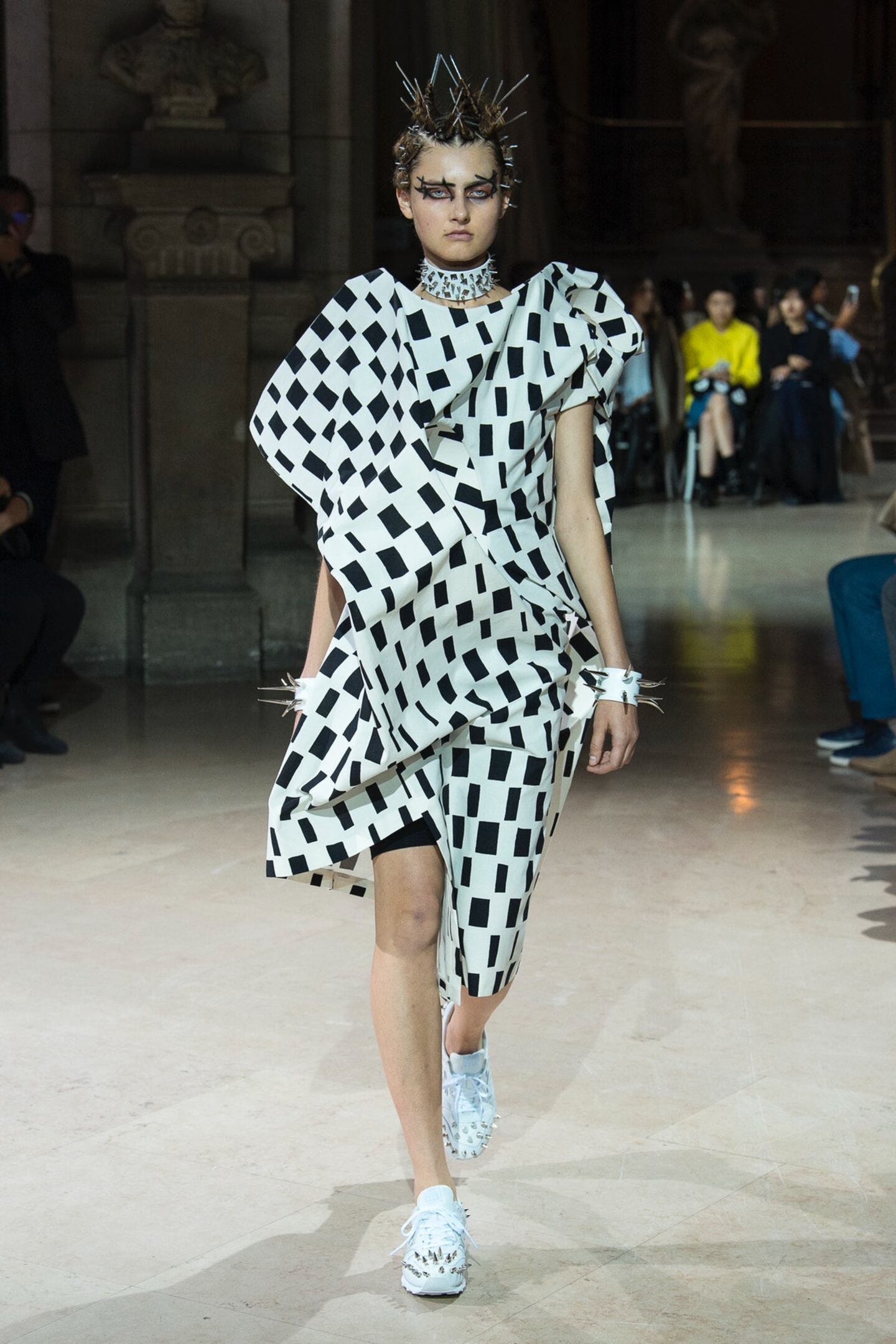
PARIS, France — Junya Watanabe's new collection was, we were informed, "an homage to curious natural forms of nature." Think about the way wind and waves work on rocks, creating curves and arches and organic shapes. The challenging silhouettes that have been Junya's own signature over the years were highly compatible with such a notion. Here there were three-dimensional effects which gently echoed erosion or geological disturbances.
His major collaboration this time was with Marimekko, the Finnish textile company whose bold patterns, also inspired by abstracted nature, contributed to the style of the 50s and 60s. (Look closely and you might have seen the words “Made in Finland” discreetly inserted into one pattern.) Even polka dots were, according to Junya’s translator, an abstract of nature.
But if the show began in birdsong, and continued to the bucolic sounds of folk rock and Johnny Mathis, there was much else that evoked the often violent disruptions in the natural order that have come to preoccupy us in the past year. The palette was monochrome, black and white, except for a couple of colour spots on the most distinctive Marimekko pattern, and a group of camouflage prints. Junya has history with camo, most dramatically in his Travis Bickle men’s collection for Autumn/Winter 2006. Its inevitable connotations with conflict worked well here with the central styling conceit of the show — nails. Woven into hair like a Mohawk of metal, projecting lethally from dog collars and cuffs, they gave the collection a literal point. Nature’s a bitch, and we’d best not piss her off. As a comment on climate change, the message might have been oblique, but it was unbeatable.
It’s not an existential crisis — yet — but Rick Owens and Daniel Roseberry confront some headscratchers in their latest collections.
Stick with the program or switch it up? Angelo Flaccavento reports on Chloé, Rabanne, Schiaparelli, Rick Owens and Uma Wang.
Haider at Tom Ford, Pieter at Alaïa, comings and goings in fashion, and Nico at Courrèges coming up fast, all of it leading to a day of dynamic fashion in Paris, writes Tim Blanks.
One of the busiest days of Paris fashion week featured a hello at Balmain, a goodbye at Alaïa and variations on signature visions at Courrèges, The Row, Dries Van Noten and Tom Ford.
The Japanese sportswear brand is accelerating global expansion by acquiring race-registration platforms to deepen engagement with runners.
The activewear giant seems intent on turning its nearly 40-year-old niche outdoor fashion brand into a mainstream success. The plan hinges on convincing backpackers and athletes its rugged technical gear can perform just as well as The North Face or Arc’teryx.
It’s not an existential crisis — yet — but Rick Owens and Daniel Roseberry confront some headscratchers in their latest collections.
Stick with the program or switch it up? Angelo Flaccavento reports on Chloé, Rabanne, Schiaparelli, Rick Owens and Uma Wang.


