Agenda-setting intelligence, analysis and advice for the global fashion community.
Agenda-setting intelligence, analysis and advice for the global fashion community.

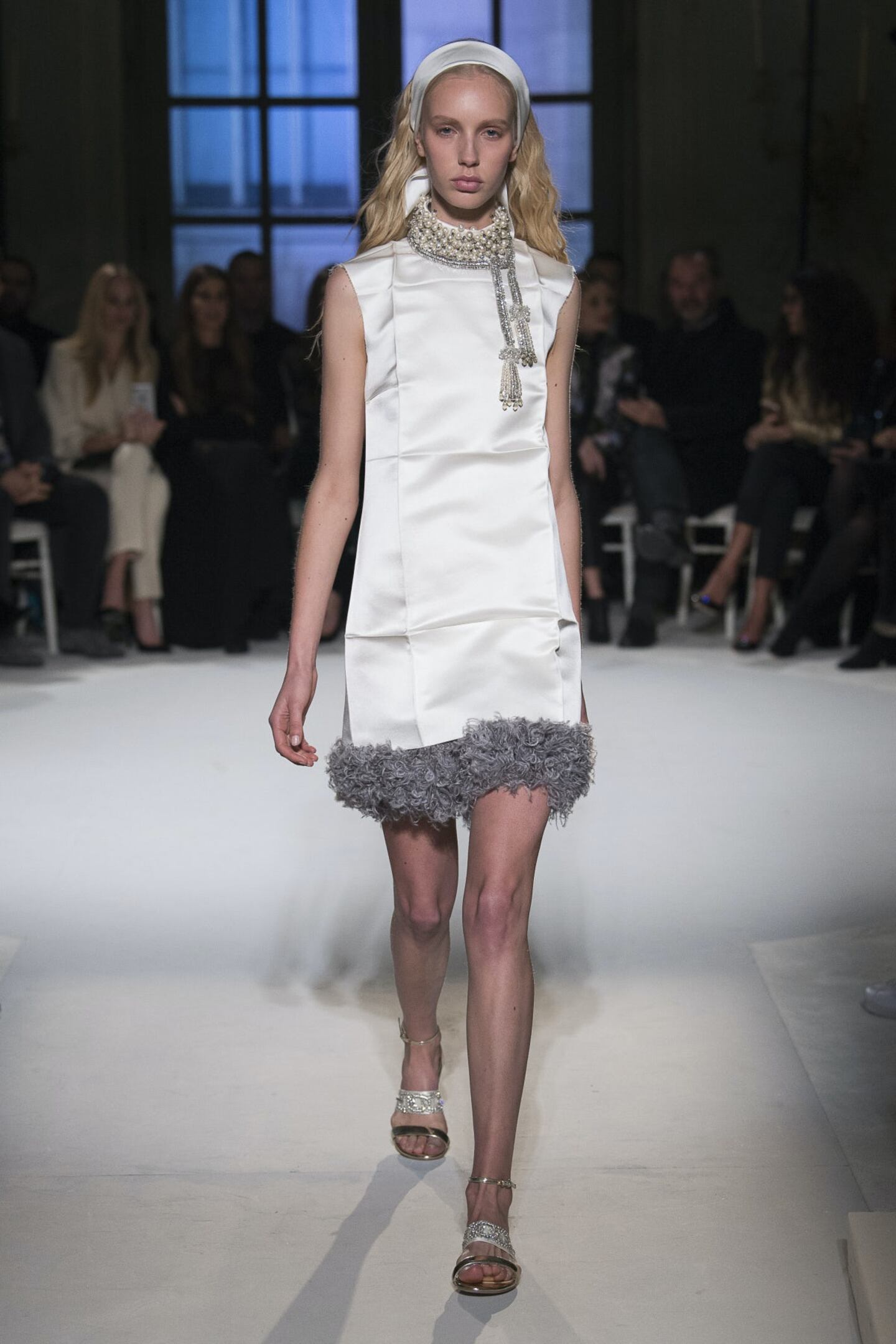
PARIS, France — "We are going to miss Franca," said Giambattista Valli, visibly moved, minutes before his show, held in the labyrithine, intensely wrought-out spaces of Paris' museum of the national archives, in the thick of the Marais. The whole system is going to miss a visionary, indeed: Sozzani passed away at a time when corporate powers are violently taking over creativity. In a way, the event marked the end of an era and the opening of even more blatantly commerce-driven, utterly unispired and non-inspiring times.
A Franca Sozzani lookalike opened the show: blond weavy hair held by a band, wearing a satin trapeze dress and an air of utter detachmant from her surroundings she glided lightly across the room. It was a heartfelt way to pay homage to a dear friend, and it was a charming way to open a show that journeyed across an eclectic collection of inspirations and stiles. Or, to put it in Valli's words, "a stroll in the mughal garden." The running thread were folding creases: dresses and tunics that looked like they just came out of a suitcase. In couture terms, it felt like a charming provocation that peppered an ever evolving detour across floaty silhouettes, frilly meringues and streamlined winks to the late sixties. It was a lot, but it worked. Giambattista Valli's knowledge of couture is encyclopaedic, but he never gets trapped in nostalgia. In his work theee is a sense of concision, a will to test different grounds that feels relevant for the moment. When he does streamlined, Valli is at his best, and this season he did a lot of that.
Stick with the program or switch it up? Angelo Flaccavento reports on Chloé, Rabanne, Schiaparelli, Rick Owens and Uma Wang.
Haider at Tom Ford, Pieter at Alaïa, comings and goings in fashion, and Nico at Courrèges coming up fast, all of it leading to a day of dynamic fashion in Paris, writes Tim Blanks.
One of the busiest days of Paris fashion week featured a hello at Balmain, a goodbye at Alaïa and variations on signature visions at Courrèges, The Row, Dries Van Noten and Tom Ford.
Controlled eroticism and an ’80s-inflected view on mid-century glamour were in focus at Tron’s debut show for the Mayhoola-backed Parisian brand.
Stick with the program or switch it up? Angelo Flaccavento reports on Chloé, Rabanne, Schiaparelli, Rick Owens and Uma Wang.
The brands Gap and Banana Republic beat comparable sales estimates.
Sex sells — if anyone can figure out what sexy means in 2026. Robert Williams tracks the search for a new silhouette at Kering’s Gucci, LVMH’s Dior and more.
Christine Hunsicker admitted she falsified financial statements to promote CaaStle Inc. as a valuable, growing business when in reality it was struggling.


