
Agenda-setting intelligence, analysis and advice for the global fashion community.
Agenda-setting intelligence, analysis and advice for the global fashion community.

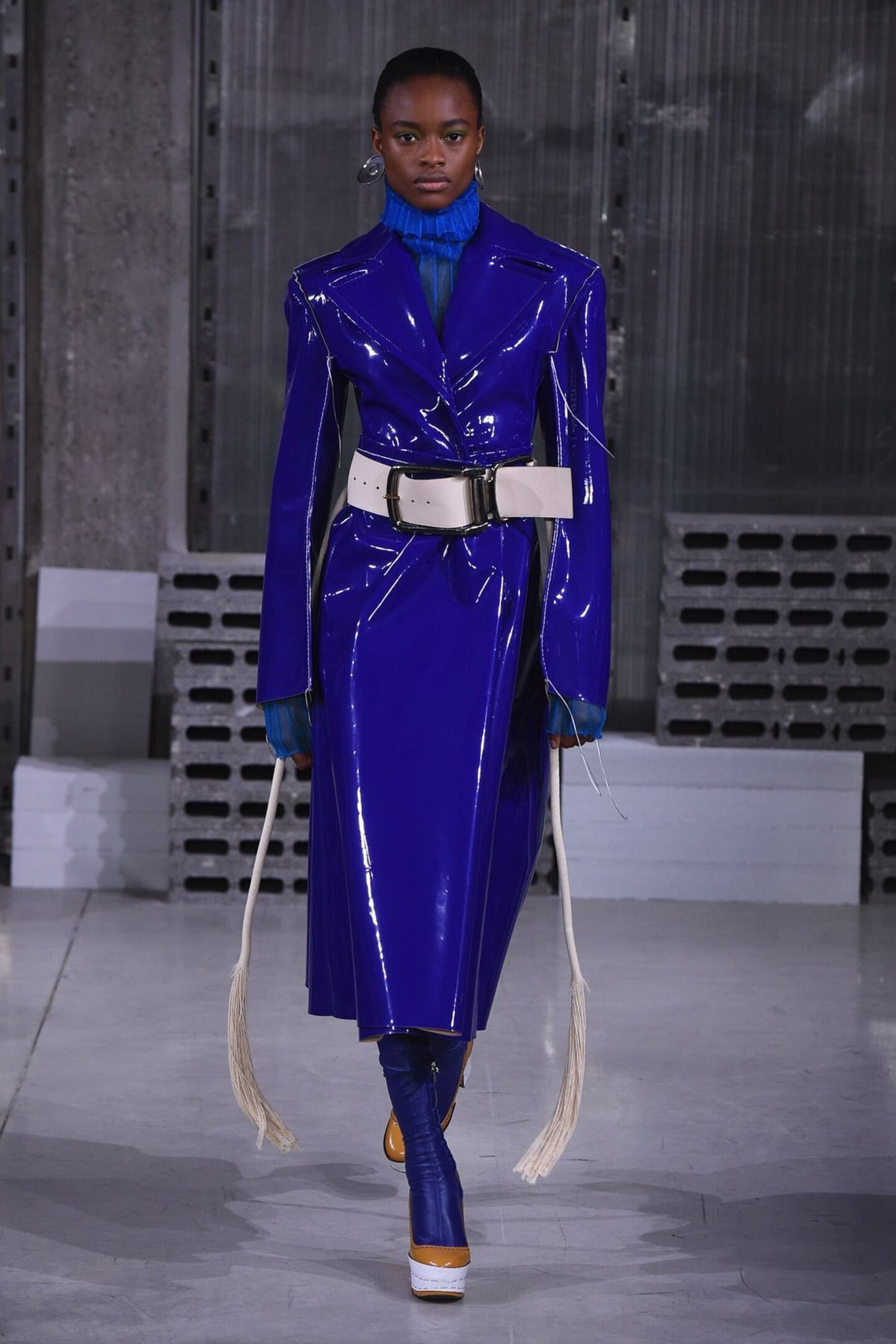
MILAN, Italy — "Elementary, my dear Watson," said Sherlock Holmes as he unpicked a web of clues to solve another case. Francesco Risso loved the notion of building a collection the same way: clues, codes, signs, a solution. And, like Sherlock, he also described the process as elementary.
But that is the fundamental naiveté of Risso's approach to Marni. On the one hand, there were the raw hems, the dangling threads and primitive top-stitching, the exaggerated proportions, the flagrant colour scheme ("women screaming with colour," he said). Elementary. On the other, there was the effort to impose order on chaos, like a kid making sense of the world. We sat on tightly wrapped bales of bedding and clothes. "After the men's show, I liked the idea of controlling the waste of stuff," said Risso. Instead of the fur that Marni's business was founded on, there was an impressive topcoat cut from the felt blankets removal men use for packing. Recycling, connecting with the natural world…he liked that idea too. "Nature brings us into primitivism," he added. His models wore peacock feathers trailing dramatically from their ears.
It was the second time this week that Victor Frankenstein — the literary inspiration for anyone engaged in the act of roughly stitching new life together – reared his head. Alessandro Michele is engaged on a similar project at Gucci. Risso talked about a "Siamese union," as in twins conjoined. The essence of the collection was that half-and-half: a coat that was half green python, half black leather, another that was industrial felting and hot pink wool. There were schizophrenic dresses that felt sophisticated on this side, turned inside out to lining on that. In one of those naïve leaps of inspiration that seem to be characteristic of Risso, he extended the idea of the Siamese into a whiskery cat motif for coats and jackets. Soundtrackist Frederic Sanchez complemented it with a recording of opera singers' warm-up exercises. They apparently "miaow" over and over again. Weird and wonderful.
"If this was a movie, it would be called 'The I, the We, The Army of Me,'" said Risso. We rocked back on our heels and thought about that for a moment. Fortunately, there were shownotes to clarify. “The individual and the collective. Being one and safety in numbers. A plurality of women…”
There was joy and fun in Risso’s Marni, but there was a message too.
Haider at Tom Ford, Pieter at Alaïa, comings and goings in fashion, and Nico at Courrèges coming up fast, all of it leading to a day of dynamic fashion in Paris, writes Tim Blanks.
One of the busiest days of Paris fashion week featured a hello at Balmain, a goodbye at Alaïa and variations on signature visions at Courrèges, The Row, Dries Van Noten and Tom Ford.
Controlled eroticism and an ’80s-inflected view on mid-century glamour were in focus at Tron’s debut show for the Mayhoola-backed Parisian brand.
After accusing the publication of ‘copying’ his remote viewing events, the creator hosted a live runway show in a 2,000-seat Paris theater.
Christine Hunsicker admitted she falsified financial statements to promote CaaStle Inc. as a valuable, growing business when in reality it was struggling.
The American cosmetic giant’s buyout of Ayurvedic beauty line Forest Essentials came as a surprise. By picking an under-the-radar brand it knows well, the company can show that it’s still in the M&A game without needing to outbid rivals.
The underwear company is anticipating net sales of at least $6.85 billion in the current fiscal year, exceeding analyst estimates and marking the highest revenue since its split from L Brands Inc in 2021.
The Japanese brand is accelerating its expansion in India to capture a greater share of the rapidly growing apparel market and affluent consumer base.


