
Agenda-setting intelligence, analysis and advice for the global fashion community.
Agenda-setting intelligence, analysis and advice for the global fashion community.

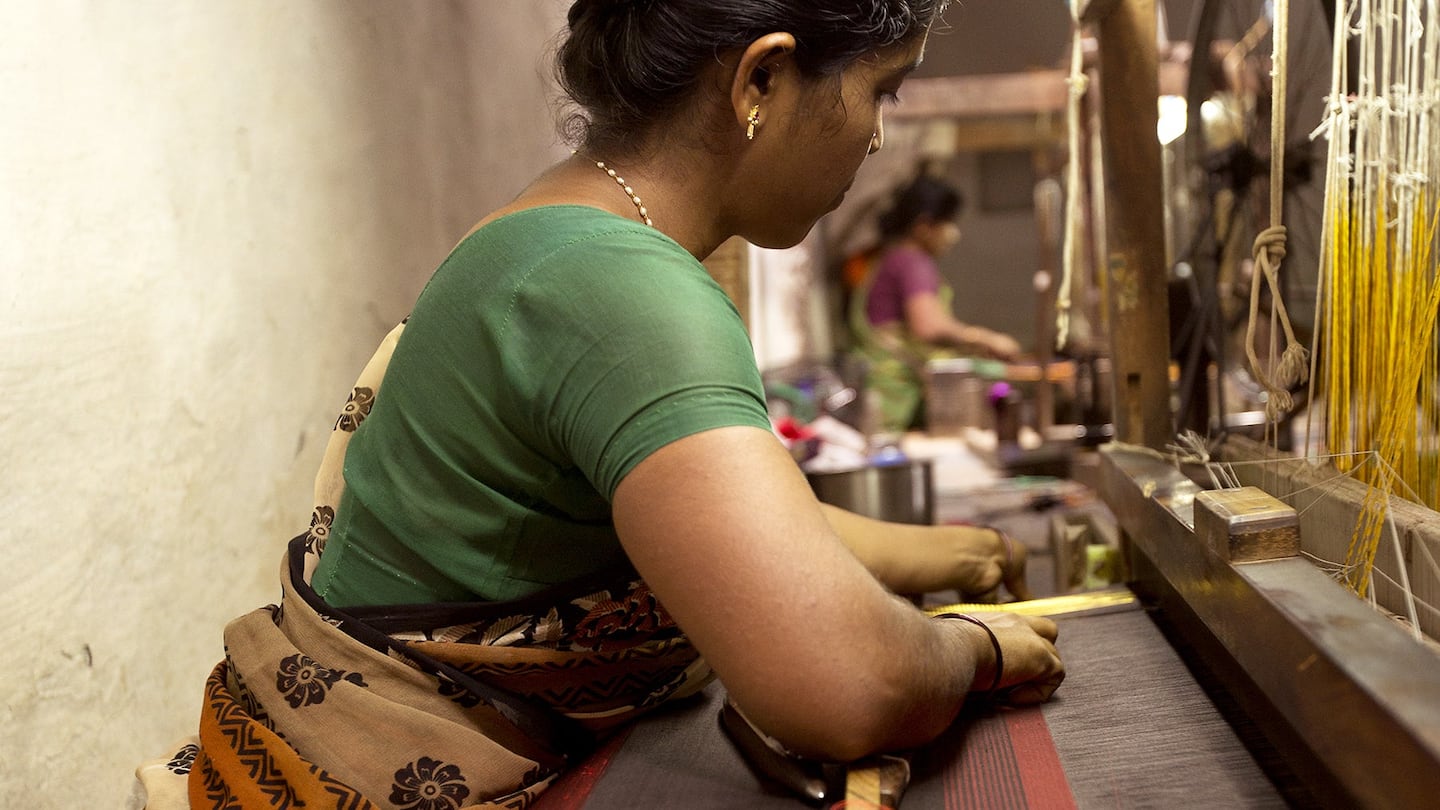
MUMBAI, India — When Indian Textiles Minister Smriti Irani tweeted a picture of herself this week in an electric-blue silk saree with the hashtag #IWearHandloom, her tweet was favourited more than 10,000 times and retweeted 4,000 times.
Hundreds responded to Irani's request to post pictures of themselves in handloom apparel, including politicians, actors, athletes, models and designers, ahead of National Handloom Day on Aug. 7, to celebrate the humble hand-woven fabric.
A symbol of India's freedom struggle, handloom attire was once regarded as fit only for politicians and villagers.
It is now seeing a revival, with demand growing for sustainable and ethical fashion, even as mass-market clothing still dominates malls and pavement stalls.
ADVERTISEMENT
"There's a greater desire among the youth and the middle class, who are frustrated with dirty politics and crooked companies, for something better," said Arvind Singhal, chief executive of retail consultancy Technopak Advisors.
"Having a greater sensitivity to people and the environment is 'in', and people are even willing to pay a small premium for what they perceive to be ethical and responsible," he said.
India is among the biggest manufacturers of textiles and apparel in the world, supplying leading international brands. But the domestic market is large too, and accounts for more than 40 percent of the industry's revenue.
The sector is dominated by small and medium-sized firms that are under enormous pressure to reduce costs and produce garments quickly. Many use forced labour, while abuses including withheld salaries and debt bondage are rife, activists say.
Wages in India's textile and garment industry are about $1.06 an hour, compared with $2.60 in China, according to the World Bank.
The pressure on margins trickles down to cotton farmers. More than 90 percent of cotton in India is genetically modified, and as those seeds cannot be replanted, farmers have struggled with rising input costs and lower prices for cotton.
Tens of thousands of indebted cotton farmers in the western state of Maharashtra have killed themselves in the past two decades.
Happy surprise
ADVERTISEMENT
It was the plight of these farmers that drove Apurva Kothari, who was working in technology in San Francisco, to return to India and set up apparel brand No Nasties in 2011.
The company sources organic cotton, and audits its supply chain to ensure there is no child labour and that workers receive fair wages, he said.
"I simply Googled 'fair trade cotton', then met with cotton producers," said Kothari, speaking by telephone from Goa.
"They all supplied foreign apparel makers, and it was a challenge convincing them there is a market here, too. But the great reception from consumers has been a happy surprise," he said.
No Nasties and Do U Speak Green are among a handful of Fairtrade-licensed clothing brands in India.
They source from producers including Rajlakshmi Cotton Mills, which deals in organic and fair trade cotton and pays fair wages, and Chetna Organic, whose seed conservation project has organic "seedbanks" from which farmers can withdraw seeds.
They are getting a boost from Fairtrade India, which set up office in 2013, and has stamped its distinct circular logo on a small range of products including tea, coffee, rice and sugar.
It is also working with Amazon India to make Fairtrade-certified products available online.
ADVERTISEMENT
"It's been a bit of a mixed bag," Abhishek Jani, chief executive of Fairtrade India, told the Thomson Reuters Foundation.
"There is a lack of technical know how, a lack of capacity, and a lack of awareness about ethical supply chains, even among big businesses. But the fact that we're invited to talk is a good starting point," he said.
Empathy elusive
Working conditions and wages in South Asia's garment industry have come under greater scrutiny since the April 2013 Rana Plaza disaster in Bangladesh, in which more than 1,100 workers died.
But retailers' efforts to clean up supply chains will have little impact unless consumers in India demand more ethically produced goods, analysts say.
"Most buyers are oblivious to farmer suicides or unfair wages, and don't make that connection to the clothes they wear," said Jani.
"But there is clearly a segment that cares, and all things being equal, more people would probably buy an ethical product if the price point isn't too high," he said.
Brands can take heart from success stories including Fabindia, said Technopak's Singhal. Set up in 1960 to market diverse craft traditions, the company appeals to both young and old consumers, the wealthy and the not-so wealthy, he said.
No Nasties' Kothari identifies similar challenges.
"How do you get people to empathise and make ethical fashion relevant? It's an uphill task, but we're optimistic," he said.
By Rina Chandran; editor: Megan Rowling.
Hours after the Supreme Court issued its decision, Trump began relying on alternative legislation to try to rebuild his tariff wall.
The new announcement stirred up more economic turbulence as president Trump lashed out at the US Supreme Court.
A majority of justices struck down the ‘Liberation Day’ tariffs that sent shockwaves through the fashion industry, setting the stage for a rush of brands trying to recoup duties they’ve already paid.
The ruling strikes down the so-called ‘Liberation Day’ tariffs that sent a shockwave through the fashion industry and sets the stage for a rush of brands trying to recoup duties they’ve already paid.
Christine Hunsicker admitted she falsified financial statements to promote CaaStle Inc. as a valuable, growing business when in reality it was struggling.
The American cosmetic giant’s buyout of Ayurvedic beauty line Forest Essentials came as a surprise. By picking an under-the-radar brand it knows well, the company can show that it’s still in the M&A game without needing to outbid rivals.
The underwear company is anticipating net sales of at least $6.85 billion in the current fiscal year, exceeding analyst estimates and marking the highest revenue since its split from L Brands Inc in 2021.
The Japanese brand is accelerating its expansion in India to capture a greater share of the rapidly growing apparel market and affluent consumer base.


