
Agenda-setting intelligence, analysis and advice for the global fashion community.
Agenda-setting intelligence, analysis and advice for the global fashion community.

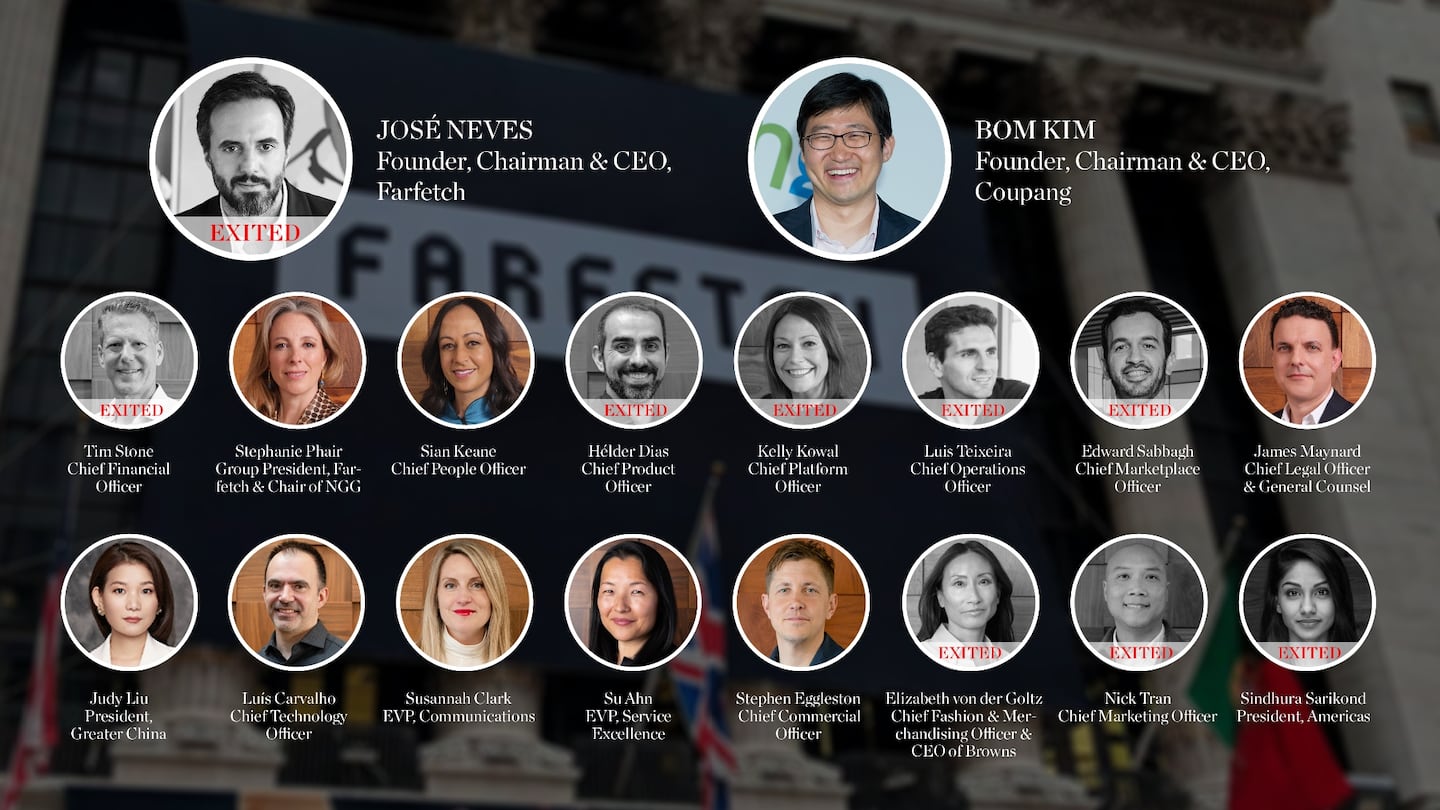
The drama at Farfetch continued to unfold on Thursday with an executive shakeup that has shocked industry insiders, even if the shotgun wedding between the embattled e-commerce player and Coupang announced in December raised eyebrows from the start.
The South Korean e-commerce company announced that José Neves, the luxury marketplace’s founder, chairman and CEO, would be stepping down, along with eight other top executives. Coupang chief Bom Kim and the remaining Farfetch team will now run the company, with Neves staying on in the capacity of a consultant.
The abrupt departure of so many top managers, which came just two weeks after the acquisition closed, was positioned by Coupang as a restructuring.
“After careful consideration we have decided to streamline the business to allow us to operate from a position of financial strength,” according to an internal memo viewed by The Business of Fashion. “This process has involved some tough decisions, but ones that are necessary for our future success.”
ADVERTISEMENT
However, the exits, which include Farfetch’s chief financial officer, chief product officer, chief marketing officer and chief operations officer, also reflected a culture clash between the existing team and the new owners, two people with direct knowledge of the matter said. Some of the executives were likely on the way out regardless, lacking confidence in the ability of Coupang, which is sometimes referred to as “South Korea’s Amazon” and has little luxury business of its own, to salvage Farfetch. The executives’ equity had also been wiped out in the deal, which rescued the company from administration, leaving little financial incentive to stick around.
Further layoffs throughout Farfetch are expected on Friday and Monday, according to the memo. A Farfetch spokesperson declined to comment.
Executive departures after an acquisition are routine, especially when the company being acquired is in financial distress. But the exit of so many leaders, including luxury industry veteran Elizabeth von der Goltz, who was chief merchandising officer, along with longtime staffers like chief platform officer Kelly Kowal, chief product officer Helder Dias and chief operating officer Luis Teixeira, only adds to the difficulties Coupang will have steering Farfetch back on course.
Company insiders said that the crucial task of maintaining the supply of luxury products is the remit of chief commercial officer Stephen Eggleston, who is staying with the business.
This will not be an easy assignment. Even before the restructuring was announced, some of Farfetch’s closest relationships with luxury brands and retailers appeared badly frayed. Earlier this month, BoF reported that Kering is winding down its relationship with Farfetch. Brands including Gucci, Balenciaga and Saint Laurent listed select goods on the marketplace and fulfilled orders directly from their own warehouses. Neiman Marcus Group also announced it had abandoned plans to use Farfetch’s e-commerce software unit, Farfetch Platform Solutions, to power Bergdorf Goodman’s online storefront and app.
While Farfetch now has the financial backing of Coupang, the loss of those partners won’t help reverse a slide in sales that had taken hold in the last year. It also will force Farfetch to rely more heavily on individual boutiques to provide high-quality inventory, as opposed to receiving popular products directly from brands.
“While one could say they were getting rid of the people that made them almost go bankrupt, they also got rid of the people that forged all alliances with all those luxury brands that are now evaporating,” Bob Phibbs, chief executive of retail consultancy The Retail Doctor, said in an email.
Farfetch’s interim executive team — which along with Eggleston includes longtime Farfetch executive and New Guards Group president Stephanie Phair, among others — will be responsible for charting a path forward. That likely means divesting non-core assets, including specialty retail department store Browns, sneaker resale site Stadium Goods, brand incubator New Guards Group and beauty retailer Violet Grey, which had been acquired in a spree of transactions that some experts say caused the business to lose its original focus as a luxury marketplace.
ADVERTISEMENT
Neves, who founded Farfetch in 2007 to connect multi-brand luxury boutiques’ inventories to its e-commerce site, built a company that became the largest distributor of luxury goods online. Farfetch sold more than $3 billion worth of high-end wares on its marketplace in 2022, and worked with more than 1,400 brands and boutiques in 50 countries. It also served as the white label e-commerce platform for major retailers like Harrods.
Coupang has indicated it plans to use Farfetch to penetrate the $400 billion global personal luxury goods market and find its footing in the US, where it is publicly listed but is not a household name. A clean break with the past, and a dynamic new leader to helm Farfetch would help towards those goals, said Bill Detwiler, managing partner at Fernbrook Capital Management, which invests in e-commerce brands.
But the question remains: “Can they find somebody to run it internally and figure it out?” Detwiler said.
The luxury marketplace's founder is one of several high-ranking employees who are leaving less than a month after the company was acquired by Coupang.
As a workaround, the embattled marketplace is considering providing “complete anonymity” to third-party retailers in exchange for sourcing certain luxury brands, according to internal documents reviewed by BoF.
The South Korean e-commerce firm Coupang has saved Farfetch from potential bankruptcy, and could use its logistical and marketing might to solve some of the luxury e-tailer’s seemingly intractable problems. But “everything stores” have a spotty track record when it comes to high-end retail.

Malique Morris is Senior E-Commerce Correspondent at The Business of Fashion. He is based in New York and covers digital-native brands and shifts in the online shopping industry.
While $1.75 billion in court-approved funding has brought labels back to the fold, the real test for vendors will come when that temporary safety net vanishes later this year.
A growing number of mass and premium brands are pushing upmarket with a more luxe look, better materials and, often, higher prices. This case study unpacks how these labels are navigating the tricky challenge of elevating a brand.
Brands from Prada to Abercrombie & Fitch will provide clarity on how the fashion industry is approaching the newly uncertain trade landscape. Plus, a preview of Paris Fashion Week.
The goods come from more than 380 brands, including Burberry and those owned by luxury powerhouses LVMH and Kering.
Activist fund Oasis Management Co. is calling on the Japanese personal care company to convene an extraordinary general meeting, seeking a probe into its supply-chain risk management and internal control.
The retailer surpassed annual sales forecasts but expects a $60 million drag from import tariffs in the first half of 2026.
The luxury Ayurvedic skincare line will be the first deal by the conglomerate under the leadership of Stéphane de La Faverie.
By introducing a new version of her Magic Cream, Tilbury joins a number of other brands, from Armani and Olaplex, wading into the tricky waters of reformulation.


