Agenda-setting intelligence, analysis and advice for the global fashion community.
Agenda-setting intelligence, analysis and advice for the global fashion community.

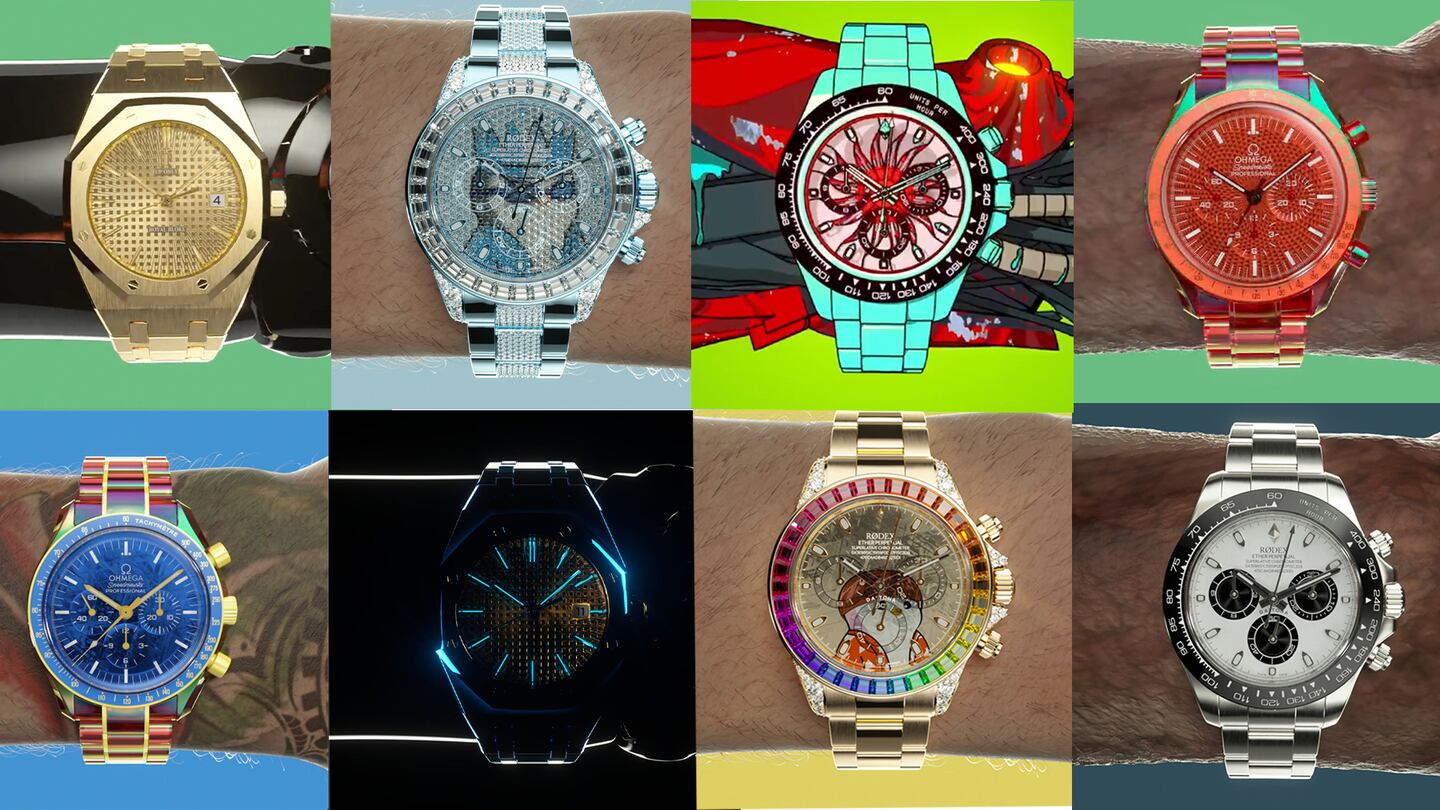
Luxury watch brands are questioning whether the burgeoning marketplace for virtual goods created by the rise of NFTs and the early stages of the metaverse presents a real opportunity or a real headache.
For opportunists, early entry into the metaverse — a persistent, parallel reality created by the stitching together of virtual worlds, where users can buy and “wear” digital goods — could give them a long-term competitive advantage. After all, the markets for luxury watches and NFTs are both rooted in a culture of collecting.
But the metaverse also challenges the core philosophy behind the sector’s biggest businesses — that mechanics and craftsmanship have deep meaning and long-lasting value. What’s more, the shapeless, unregulated metaverse is a virtual Wild West for carefully crafted reputations.
Whatever the calculus, few are ignoring the phenomenon.
ADVERTISEMENT
In January, LVMH chairman Bernard Arnault said during the company’s earnings call that the metaverse presented a business opportunity, but struck a note of caution, saying the group was in no rush to “sell virtual sneakers for €10.”
Watchmakers have begun to dabble in the space. Last year, Jacob & Co. became the first high-end brand to sell a digital version of one of its watches, the NFT SF24 Tourbillon, which sold at auction for $100,000. In February, Louis Moinet, which makes only a few hundred physical watches a year, offered its first NFT collection, a run of 1,000 unique pieces that it says sold out in seven minutes when it went on sale last month.
But much remains behind closed doors. Stéphane Bianchi, head of LVMH’s Watch and Jewellery division, confirmed in January that brands in his stable – which includes Bulgari, Hublot and TAG Heuer – were experimenting with the technology. “At the end of the day we should be part of it and we will be,” he told the New York Times in January.
TAG Heuer’s chief executive Frédéric Arnault confirmed the brand is exploring the space, while Bulgari’s chief executive Jean-Christophe Babin said he sees huge potential in NFTs and the metaverse. “The metaverse could be a magnifier of the real world and take us into a dreamland, like Alice in Wonderland,” Babin said. “This then creates huge value.”
But the metaverse also opens up a world of legal wrangling. In January, Hermès sued Mason Rothschild over his “MetaBirkin” NFTs, claiming trademark infringement. It’ll be interesting to see what becomes of Generative Watches, a collection of 1,000 NFTs that ape designs by Switzerland’s two largest watchmakers.
What Rolex makes of founder Jesus Calderon’s “Rødex Bitmariner,” a swipe at the superbrand’s signature Submariner design, remains to be seen. In the meantime, Calderon told the watch website Hodinkee earlier this year that he’d sold 68 virtual watches for around $700 a piece, and that one he’d given away changed hands on the secondary market for the equivalent of $20,000.
For now, brands are left with more questions than answers.
Given real-world watches are designed using 3D software, producing watch NFTs would be relatively cheap and easy. But how to set appropriate volumes and retail prices? “The laws of the metaverse will be very similar to the real world,” said Babin. “If you make a few, they cost a lot. If you make many, they cost little. But whether the price should be higher or lower than the real piece — it’s difficult to say.”
ADVERTISEMENT
For all its cultural influence, the Swiss watch industry remains highly conservative, and many brands are expected to steer clear of the metaverse. “The Swiss brands will worry about perception and they’ll be really late to the party,” said William Rohr, former managing director of watch forum TimeZone and founder of watch brand Massena LAB.
“But if they decide to invest, big guns like Rolex will invest massively and try to occupy as much space as possible, because the rest of the industry will follow like a herd,” he added. “I think that this will happen in the second part of this decade.”
 Opens in new window
A team dedicated to web3 projects will be creating NFTs for Highsnobiety and helping brands execute their own projects by providing creative and technical assistance.
Even if the luxury brand wins its case against the creator of the virtual interpretations of its famed bag, the NFTs can’t be erased, at least not in any conventional sense.
The LVMH chairman said, “It’s not our objective to sell virtual sneakers for 10 euros,” contrasting with rival Gucci’s bullish approach.
Robin Swithinbank is a contributing writer at The Business of Fashion. Swithinbank is a London based journalist, editor, and speaker who specialises in luxury watches.
Sex sells — if anyone can figure out what sexy means in 2026. Robert Williams tracks the search for a new silhouette at Kering’s Gucci, LVMH’s Dior and more.
Strong growth at Miu Miu helped lift results, but the Italian luxury group said that integrating Versace will weigh on margins in the near term as it begins the turnaround of the struggling brand
After Swatch Group launched an attack on Morgan Stanley’s influential annual watch report, Swatch-owned Tissot cracks open the door for a glimpse at some numbers and Robin Swithinbank says it’s time a secretive industry came clean on financials.
Half a year after Giorgio Armani’s death, it appears to be business as usual at the sprawling fashion empire while potential investors continue to circle with no firm bid in sight.
Stick with the program or switch it up? Angelo Flaccavento reports on Chloé, Rabanne, Schiaparelli, Rick Owens and Uma Wang.
The brands Gap and Banana Republic beat comparable sales estimates.
Sex sells — if anyone can figure out what sexy means in 2026. Robert Williams tracks the search for a new silhouette at Kering’s Gucci, LVMH’s Dior and more.
Christine Hunsicker admitted she falsified financial statements to promote CaaStle Inc. as a valuable, growing business when in reality it was struggling.


