Agenda-setting intelligence, analysis and advice for the global fashion community.
Agenda-setting intelligence, analysis and advice for the global fashion community.

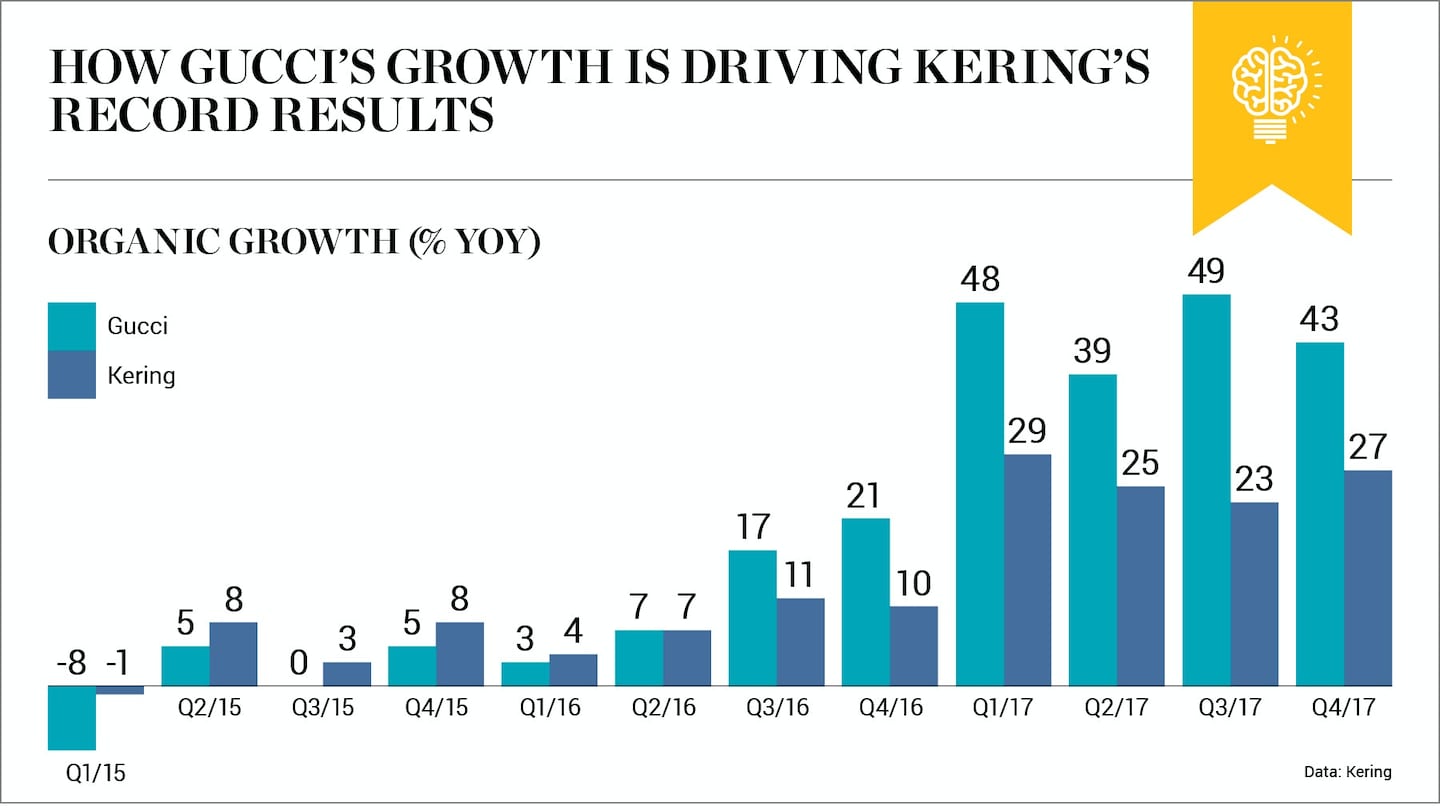
PARIS, France — On Tuesday, French conglomerate Kering reported its most profitable year in history, led by continued explosive growth at Gucci, with sales at the Italian megabrand up by 42.6 percent in the fourth quarter, reaching €6.2 billion ($7.6 billion) for 2017 overall. Indeed, Gucci makes up 57 percent of Kering's luxury business revenue and 73 percent of operating income. Kering revenues for fiscal year 2017 rose by 27.2 percent to €15.5 billion ($19 billion at current exchange).
Gucci has long been Kering's cash cow and its performance has mirrored the group's growth since it acquired a controlling stake in the Gucci Group in 1999. But in the latter years of Frida Giannini's tenure, which lasted from 2006 to 2016, near-zero growth rates at Gucci were reflected in low performance at Kering overall.
The group's organic growth rate didn't reach beyond 10 percent until the third quarter of 2016, when current Gucci chief executive Marco Bizzarri and creative director Alessandro Michele's efforts began to yield results. Sales rose at the quickest pace since 2012, 10.4 percent for Kering and 21 percent for Gucci — twice as fast as analysts expected. After operational adjustments and the introduction of a creative reboot anchored by a maximalist magpie aesthetic popular with Millennials, Bizzarri and Michele have turned Gucci into a new blockbuster.
“Gucci’s momentum in 2018 will remain, and they will continue gaining market share, but it will be impossible to keep up with the over 40 percent growth of 2017 driven by the catching up of Gucci to what was its natural market share," said Mario Ortelli, senior luxury goods analyst at Sanford C. Bernstein.
ADVERTISEMENT
Does Gucci's lead at Kering mean a mega-brand must always anchor a conglomerate? Louis Vuitton, after all, generates almost $12 billion in revenue and makes up almost half of the operating profit in the entire LVMH empire, according to Bernstein estimates. While dependence on Gucci needn't be negative, "the real issue is trying to keep a sustainable growth over time," said Ortelli. "It will be crucial to provide a well-balanced mix between newness and continuative products, possibly developing evergreen leather products."
While Kering does rely on the Italian brand for over half of its revenue and EBIT, it has also benefited from the blockbuster success of Saint Laurent, which posted 2017 revenues of €1,5 billion ($1,85 billion), up 25.3 percent year-on-year, driving 14 percent of luxury group sales and almost a quarter of operating profit.
Balenciaga has also raised its ambitions, with the goal to become a €1 billion business as chief executive Cédric Charbit capitalises on the momentum and disruption created by its creative lead, Demna Gvasalia, and the success of the brand's footwear and leather goods categories. While Balenciaga — along with Kering's group of smaller luxury brands division that also includes Alexander McQueen and Stella McCartney — currently accounts for 18 percent of the luxury group's revenue and 4 percent of operating profit, it delivered the fastest growth rate of all of Kering's brands in the second half of 2017.
Ultimately, the group's guidance during its full year results was not buoyant, but solid. While Kering’s blockbuster success can mainly be attributed to the rise of Gucci, diversifying the group's portfolio as it seeks to become a pure-player of luxury will be the key to long-term sustainable growth.
"Considering their strong balance sheet position, and a debt to equity ratio below one, a more aggressive M&A strategy would be appreciated by investors," said Ortelli.
Related Articles:
[ Gucci Boosts Kering's Fourth-Quarter Sales GrowthOpens in new window ]
[ How Long Can Kering’s Blockbuster Success Continue?Opens in new window ]
After Swatch Group launched an attack on Morgan Stanley’s influential annual watch report, Swatch-owned Tissot cracks open the door for a glimpse at some numbers and Robin Swithinbank says it’s time a secretive industry came clean on financials.
Half a year after Giorgio Armani’s death, it appears to be business as usual at the sprawling fashion empire while potential investors continue to circle with no firm bid in sight.
Kering, LVMH and OTB all have significant skin in the game this Milan Fashion Week with new designer runway debuts at storied Italian brands.
How designer Erdem Moralioğlu’s label has outlived peers, surviving Brexit and the bankruptcies of Barneys, Matches and Saks with a consistent and soulful signature rooted in a fascination with the feminine, the tension between control and ‘undone-ness’ and an obsession with beauty.
Activist fund Oasis Management Co. is calling on the Japanese personal care company to convene an extraordinary general meeting, seeking a probe into its supply-chain risk management and internal control.
The retailer surpassed annual sales forecasts but expects a $60 million drag from import tariffs in the first half of 2026.
The luxury Ayurvedic skincare line will be the first deal by the conglomerate under the leadership of Stéphane de La Faverie.
By introducing a new version of her original Magic Cream, Tilbury treads into the tricky territory of reformulation, a necessary risk that can reinvigorate a staid product — or destroy a best-seller.


